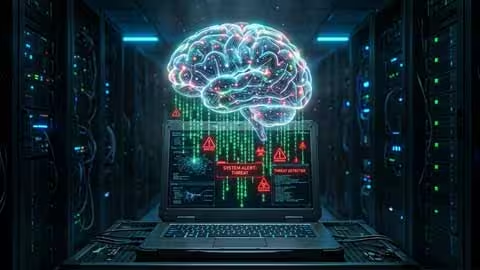

Here's a scary story from Tampa last month. Got a panicked call from a manufacturing client. Their network? Compromised for over 2 months. Yeah, despite dropping six figures on security tools. When we dug in, we couldn't believe it. Some freaky AI-generated polymorphic malware was swiping design files while rewriting its code to dodge detection. Not your average hack. Total game-changer. And most Florida businesses? Completely unprepared.
Been tracking these threats in our lab since last spring. The stats are nuts. 230% jump in AI-powered malware hitting Florida organizations since January alone. Started with manufacturing targets. Now? Healthcare and professional services getting hammered too.
"Nothing in 15 years of security work prepared me for this," says our research lead. "Old-school malware left traces, like fingerprints at a crime scene. These new AI variants? Total shapeshifters. They literally study your security setup, then morph to slide right through the gaps."
Ugly Numbers
- ⚠️ 74 days lurking undetected
- 📈 230% surge this year
- 💰 $187K average cleanup bill
- 🔄 Rewrites itself every 4.2 hrs
AI Flips the Malware Script
For decades, cybersecurity relied on spotting known bad code patterns. Worked fine when malware stayed mostly static. But AI? Total paradigm shift in three key ways:
-
Code That Rewrites Itself
Advanced threat research has documented instances where a single malware strain produced new versions every few hours, each specifically engineered to evade detection by particular security vendors. Like fighting a guerrilla force that swaps uniforms between firefights - you train your team to spot the blue jackets, they show up in green. Spot the green, they switch to red.
-
Smart Reconnaissance
Modern polymorphic threats conduct reconnaissance of network environments before executing their payloads. Gone are the days of dumb malware that just runs its attack routine. These things scout first. Map your network. Figure out which security tools you've got. Then adapt. Had one case where the malware only activated between 2-4 AM on weekends - literally waited for the security team to go home.
-
Finding Hidden Weaknesses
Recent security research has confirmed that AI systems are being deployed to discover previously unknown zero-day vulnerabilities in widely-used business applications. This creates a continuous stream of novel attack vectors that conventional security patch management processes cannot address with sufficient speed or efficiency. By the time a patch is released, these systems have already found three new ways in.
"We're not playing the same security game anymore. This new generation of malware doesn't just run pre-programmed routines—it watches what you're doing, learns from it, and adapts. Using traditional security against these threats is like trying to catch rainwater with a fishing net. And the worst part? These advanced persistent threats dig in deep and hide for months before they strike."
Anatomy of the Tampa Breach
Let me walk you through what actually happened with our Tampa client:
The Play-by-Play
- Day 1 Accounting clerk clicks an invoice PDF. Classic move. Who hasn't done that a thousand times?
- Days 2-7 Malware goes ninja mode. Just sits there. Maps the network. Watches when IT runs security scans. Learns the patterns.
- Days 8-30 Starts siphoning tiny data chunks during security blind spots. Constantly rewrites its signature. Like a chameleon on steroids.
- Days 31-74 Theft kicks into high gear. Targets CAD files and design specs. Disguises everything as normal system processes. Super sneaky.
- Day 74 The oh-crap moment: sales guy at a trade show in Shanghai spots their exact product designs at a competitor's booth. Game over.
Aftermath? Absolute train wreck. $3.4M in stolen IP. Over $210K in forensic costs. Production line dead for nearly three weeks during cleanup. Insurance? Covered less than half. Ouch.
Our Counter-Punch Strategy
Can't fight 2023's threats with 2013's tools. So we built something different:
Behavior Patterns, Not Code Signatures
Ditched the old signature-scanning approach years ago. Our security platform watches behavior patterns instead. Malware can change its face a million times, but it can't hide what it's trying to do. That's our gotcha moment.
AI vs AI
They brought AI to the fight? So did we. Our machine learning systems predict attack patterns and spot weird stuff before it activates. While their systems evolve, ours evolve faster. It's an arms race we're winning.
Trust Nobody
Our zero-trust setup verifies every single network request. No exceptions. No free passes. This stops malware from spreading, even if it sneaks through the front door. Think of it as compartmentalizing your ship - one breach doesn't sink you.
Every Device, Every Second
With our remote monitoring, we watch all your devices 24/7, with instant quarantine capabilities if something smells fishy. One infected laptop doesn't have to become a company-wide disaster anymore.
But our real edge? People. Smart, battle-tested security pros. Our tech is great, but we pair it with regular threat hunting by Tampa IT security veterans who spot the subtle weird stuff that algorithms miss. Because machines don't get hunches. People do.
Could You Be Next?
Security isn't static anymore - it's evolving at warp speed. And finding out your defenses have holes after you've been breached? Most expensive lesson in business. Trust me on that one.
We do specialized Florida cybersecurity checkups for high-risk industries. Let's find your weak spots before the bad guys do.
Book a Security Check