A $569 Million AI Server Factory Goes Dark at 3:30 AM
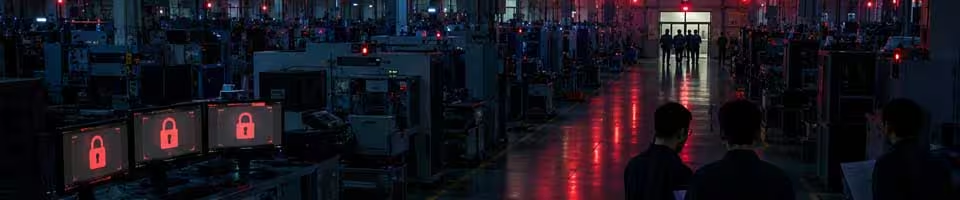
Picture this: it's May 1, 2026, and somewhere in Mount Pleasant, Wisconsin, a $569 million Foxconn facility — the one building next-generation AI servers for the biggest names in tech — suddenly goes silent. Network connections drop. Systems freeze. And the thing is, nobody on the night shift knows what's happening yet.
By 7:00 AM, WiFi is completely cut. By 11:00 AM, workers are sent home. Paper timesheets replace digital ones. It feels like someone yanked a massive factory back into the 1990s overnight.
The truth is that what happened at Foxconn isn't just another ransomware headline you scroll past. This is a supply chain attack — and if you do business with any vendor that touches technology (spoiler: you do), then what happened to Apple, NVIDIA, and Google's data at that plant could happen to YOUR data through YOUR vendors.
"The Nitrogen ransomware group claimed responsibility for stealing over 8 terabytes of data — more than 11 million files — including hardware schematics and data center topology from some of the world's most valuable companies."
Timeline: How the Foxconn Nitrogen Attack Unfolded
Let's break down exactly what happened, because the speed of this attack is something every business owner needs to understand:
| Date & Time | Event | Impact |
|---|---|---|
| May 1, ~3:30 AM ET | Network outages begin at Mount Pleasant facility | Internal systems start failing silently |
| May 1, 7:00 AM ET | WiFi completely cut across the facility | Workers lose access to all digital systems |
| May 1, 11:00 AM ET | Workers sent home | Production halted, paper timesheets issued |
| May 1–10 | Houston, Texas facility also confirmed affected | Multi-site disruption across North America |
| May 11 | Nitrogen posts on dark web leak site | Claims 8TB / 11M+ files stolen |
| May 12 | Foxconn officially confirms the attack | Public disclosure after nearly two weeks |
Nearly two weeks. That's how long it took between the initial breach and public acknowledgment. In addition, the Houston facility was hit too — meaning this wasn't a localized failure. The attackers had deep network access across multiple geographic locations.
Why Supply Chain Attacks Should Terrify Every Business Owner
Here's the part that most people miss, and it's the part that matters most to YOU: Foxconn doesn't just make stuff for Foxconn. They manufacture critical components for Apple, NVIDIA, Google, Intel, Dell, and dozens of other companies. When Foxconn gets breached, their clients' data gets breached too.
Think of it like this — imagine you store your most valuable documents in a high-security vault at a bank. You trust the bank. You have your own security. But then someone breaks into the bank itself. Your vault isn't safe anymore, no matter how good YOUR lock was.
That's exactly what a supply chain attack does. And the thing is, the stolen data allegedly includes:
- Hardware schematics from Apple's upcoming products
- NVIDIA's data center topology and GPU architecture details
- Google's proprietary server configurations
- Intel's chip design documentation
- Dell's infrastructure blueprints
Now, AppleInsider analysis suggests that the Apple-specific data may not include actual product schematics — it could be limited to manufacturing process documentation. But even manufacturing details are incredibly sensitive. Competitors would pay handsomely for that intelligence, and nation-state actors would love to understand how these systems are built.
Our cybersecurity services include vendor security assessments and supply chain risk analysis to help identify vulnerabilities in your extended business network before attackers do.
Who Is Nitrogen? Understanding the Threat Actor
Nitrogen isn't some random amateur crew. They operate a sophisticated double-extortion model — first they steal your data, then they encrypt your systems, and then they threaten to publish everything unless you pay. It's a one-two punch that leaves victims with no good options.
Here's what makes Nitrogen particularly dangerous:
- ALPHV/BlackHat connection: Nitrogen has documented ties to the ALPHV (also known as BlackHat) ransomware ecosystem — one of the most prolific and technically advanced criminal operations in history
- Double-extortion model: They don't just encrypt — they exfiltrate massive amounts of data first, giving them leverage even if you have backups
- Targeted approach: They specifically target high-value manufacturing and supply chain companies where the stolen data has strategic value beyond just ransom
- Professional operation: Their dark web leak site is organized and regularly updated, suggesting a well-funded and structured criminal enterprise
| Nitrogen Characteristic | Detail | Risk Level |
|---|---|---|
| Attack Model | Double extortion (steal + encrypt) | Critical |
| Affiliations | Ties to ALPHV/BlackHat ecosystem | Critical |
| Data Volume (Foxconn) | 8TB / 11M+ files | Catastrophic |
| Target Profile | High-value manufacturing, supply chain | High |
| Geographic Reach | Multi-site, cross-state attacks | High |
Foxconn's Pattern: This Is Their FOURTH Cyber Incident Since 2020
Here's something that should make you sit up straight: this isn't even Foxconn's first rodeo. In fact, this is their fourth major cyber incident in just six years:
- 2020 — Mexico facility: DoppelPaymer ransomware hit their Ciudad Juárez plant, encrypting around 1,200 servers and demanding a $34 million ransom
- 2022 — Mexico facility again: LockBit ransomware targeted another Mexican operation
- 2024 — Subsidiary breach: A Foxconn subsidiary suffered a data breach
- 2026 — Wisconsin + Texas: Nitrogen ransomware steals 8TB from North American AI server facilities
Four incidents. Four different ransomware groups. And each one gets progressively worse. The truth is that if a company keeps getting breached like this, it tells us something uncomfortable: either their security posture isn't improving fast enough, or the threat landscape is evolving faster than their defenses.
And that should worry you — because if a company with Foxconn's resources can't keep attackers out, what about YOUR vendors? What about the smaller companies in your supply chain that don't have billion-dollar security budgets?
What This Means for YOUR Business
Let's get real for a second. You might be thinking, "I'm not Apple. I'm not NVIDIA. Why should I care?" And the thing is, that's exactly the wrong way to think about supply chain security.
Here's why this attack matters to businesses of ALL sizes:
- Your vendors have YOUR data: Every cloud provider, SaaS tool, managed service provider, and IT vendor you use holds some of your sensitive information. Their breach is your breach.
- Smaller companies are easier targets: If Nitrogen can hit Foxconn, imagine what a motivated attacker could do to a mid-size company with limited security resources
- Regulatory exposure: Depending on your industry, a vendor breach that exposes your client data can trigger compliance violations and fines — even if YOU did nothing wrong
- Reputational damage cascades: When your vendor gets breached and your clients' data leaks, they blame YOU — not your vendor
Think about it this way: your security is only as strong as the weakest link in your entire vendor chain. And after Foxconn's fourth breach, that should keep every business owner up at night.
Our backup solutions include air-gapped storage and regular validation testing to ensure your data stays recoverable even during supply chain attacks.
How to Protect Your Business: Actionable Steps
Alright, enough about the problem. Let's talk solutions. Because the good news is that you CAN dramatically reduce your exposure to supply chain attacks like the Foxconn-Nitrogen incident. Here's what works:
1. Network Segmentation
Don't let everything talk to everything. Segment your network so that if one area gets compromised, attackers can't move freely through your entire infrastructure. The Nitrogen group was able to hit both Wisconsin AND Texas — that suggests insufficient segmentation between sites.
2. Vendor Security Audits
You need to know what security measures your vendors have in place. Ask tough questions:
- How do they segment their networks?
- What's their incident response plan?
- How quickly can they detect and contain a breach?
- Do they maintain air-gapped backups?
- What certifications do they hold (SOC 2, ISO 27001)?
3. Air-Gapped Backups
This is non-negotiable. Air-gapped backups — meaning backups that are physically disconnected from your network — are your ultimate safety net. Double-extortion groups like Nitrogen specifically look for and destroy network-connected backups. If your backups are air-gapped, they can't touch them.
4. Zero-Trust Architecture
Stop trusting anything by default. Every access request should be verified, every connection should be authenticated, and every user should prove they are who they say they are — every single time.
5. Incident Response Planning
Have a plan BEFORE you need it. Know exactly who does what when an attack happens. Practice it. Update it quarterly. Because when a Nitrogen-style attack hits at 3:30 AM, you don't want to be figuring things out on the fly.
Our cybersecurity team implements network segmentation, zero-trust architecture, and comprehensive monitoring to protect your business from sophisticated threats like Nitrogen ransomware.
The Double-Extortion Playbook: Why Backups Alone Aren't Enough
Let's address the elephant in the room. Some people hear "ransomware" and think, "I have backups, I'm fine." But double-extortion changes the game completely.
Here's how it works with groups like Nitrogen:
- Phase 1 — Silent infiltration: They're in your network for days or weeks, quietly mapping everything and stealing data
- Phase 2 — Mass exfiltration: They copy everything valuable to their servers (8TB in Foxconn's case)
- Phase 3 — Encryption: NOW they encrypt your systems, shutting down operations
- Phase 4 — Double leverage: Pay up, or we publish your stolen data AND your systems stay encrypted
See the problem? Even if you restore from backups and get your systems running again, they still have 8 terabytes of your most sensitive data. That's where comprehensive security — not just backups — becomes essential.
You need:
- Detection capabilities to catch the silent infiltration phase
- Network monitoring to spot unusual data transfers before 8TB walks out the door
- Data loss prevention (DLP) tools to flag and block unauthorized data movement
- Encrypted communications so even if data is intercepted, it's useless
- Air-gapped backups as your recovery safety net
Our comprehensive backup solutions combine air-gapped storage with network monitoring and data loss prevention to protect against the full double-extortion playbook used by groups like Nitrogen.
Lessons from the Foxconn Breach: Key Takeaways
Let's distill everything we've learned from this incident into actionable intelligence you can use right now:
| Lesson | What It Means | Your Action Item |
|---|---|---|
| Supply chain = your risk | Vendors' failures become your failures | Audit vendor security quarterly |
| Repeated breaches are a red flag | 4 incidents in 6 years = systemic issue | Track vendor incident history |
| Multi-site attacks are real | Attackers move laterally across locations | Segment networks between sites |
| Detection time is critical | 12 days before public confirmation | Implement 24/7 monitoring |
| Double extortion changes everything | Backups alone don't solve the problem | Layer backups + DLP + monitoring |
Don't Wait for Your Wake-Up Call
Foxconn's $569 million AI factory went dark in the middle of the night. Workers showed up to a facility running on paper and confusion. It took nearly two weeks for the company to even acknowledge what happened.
The truth is that most businesses don't take supply chain security seriously until it happens to them. But by then, it's too late. Your data is already on a dark web leak site. Your clients are already exposed. Your reputation is already damaged.
You're reading this article, which means you're already ahead of the curve. You're already thinking about this the right way. The question is: what are you going to DO about it?
Every day you wait to secure your supply chain is another day you're trusting that YOUR vendors won't be the next Foxconn. And based on the evidence, that's a bet no smart business owner should make.
Ready to protect your business from supply chain attacks? Our cybersecurity team can assess your vendor risk, implement network segmentation, and build a comprehensive defense strategy tailored to your business needs.